
Origin
Coffee arabica was born in an Ethiopian forest, took a long road through Yemen, Turkey, and colonial Europe, and eventually landed on a red-soil hillside in central Vietnam. This is the short version — the one worth telling.
It started in a forest.
Coffee did not begin as a crop. It began as an understory plant in the cloud forests of Kaffa, in southwest Ethiopia, where Coffea arabica still grows wild under a shifting canopy of taller trees. Local custom decides where in the forest it may be picked, and by whom. Yields there are a fraction of what a full-sun Brazilian plantation produces — that is not the point.
Wild arabica lives between roughly 1,000 and 2,000 metres above sea level, on either side of the Rift Valley, extending into the Boma plateau on the border with South Sudan. Botanists at Kew Gardens hold that traffic went both ways across the Red Sea — coffee moved out to Yemen, adapted to a drier terroir, and centuries later parts of that adapted stock came back home.
Why we call it arabica.
By the sixth century, coffee trees had reached the Arabian peninsula — likely carried across the Red Sea by Ethiopians who ruled Yemen for fifty years. By the fifteenth century, Sufi monks in Yemen were brewing qahwa — first from khat leaves, then from an infusion of the dried coffee fruit, later from the roasted beans themselves.
In 1753, Carl Linnaeus opened his Species Plantarum and put the epithet arabica next to the genus Coffea. Ethiopia, the plant’s actual home, was politely written out of its own scientific name. The Port of Mokha, on Yemen’s coast, gave the world its first taste and its first trade route.
From Cairo to Vienna.
Coffee moved as religion, then as habit. It reached Egypt in the 1500s. When the Ottomans conquered Egypt in 1516, soldiers carried it home. In Turkey, in the sixteenth century, the cezve was invented — the first fast brewer, requiring two things coffee had never needed before: a darker roast and a finer grind. The first stone grinders followed.
Coffee reached Europe through Ottoman contact. It became fashionable in Paris in the 1670s thanks to the parties of a Turkish ambassador. In 1683, Ottoman armies retreating from the siege of Vienna are said to have left sacks of beans behind. From that point onward, the coffeehouse was a European institution.
A French priest, a hillside, a seedling.
Coffee arrived in Vietnam in 1857, planted by French missionaries in the northern hills near Kẻ Sở. It stayed small — a curiosity, a mission garden — for two more decades. Commercial plantations followed in the 1880s. By the 1920s the French colonial administration had pushed coffee up into the Central Highlands, into the volcanic red soil around Buôn Ma Thuột. That is where the story became a scale.
The war years broke the industry. The country’s rebuilding after 1975 broke it again. Then, in 1986, the Đổi Mới reforms opened the economy, land rights were extended to smallholders, and coffee planting exploded across Dak Lak, Gia Lai, and Kon Tum.
How Vietnam became the world’s second-largest producer.
Between 1990 and 2000, Vietnam went from a footnote to the second-largest coffee producer on earth — a position it has not surrendered. About ninety-five percent of that production is robusta (Coffea canephora), grown low, grown hardy, grown for volume. Most of it is dried on the farm and pushed straight into the instant-coffee supply chain.
Robusta is where most Vietnamese coffee culture actually lives. The phin — the small steel filter that sits on a glass over sweetened condensed milk — is a robusta ritual, worked out over a century, and one of the great everyday brewing objects in the world.
Lâm Đồng, altitude, and a different question.
The specialty shift started in the south, in Lâm Đồng — the province around Đà Lạt — where farms sit high enough for arabica to make sense. Between 1,300 and 1,700 metres, the daytime average holds between 17 and 23°C, the range where a coffee plant actually stores sugars in its seed. Below that band, the plant is asleep.
By the mid-2010s, small producers were shifting varieties, replanting with Typica and Bourbon, installing washing stations, learning selective picking. A generation of young Vietnamese producers started asking a different question — not how much, but how good. Fine robusta emerged as its own category. Co-ferments — cherries fermented with fruit or yeast strains — became a Vietnamese specialty.
Our current selection.
Everything we roast at Lot | 23 comes from Lâm Đồng — the highlands around Đà Lạt, between 1,300 and 1,700 metres. Small farms, selective picking, cup-graded lots. Two arabica varieties (Typica and Catimor), one fine robusta, one co-ferment. Nothing anonymous, nothing mixed.
Four coffees, one province.
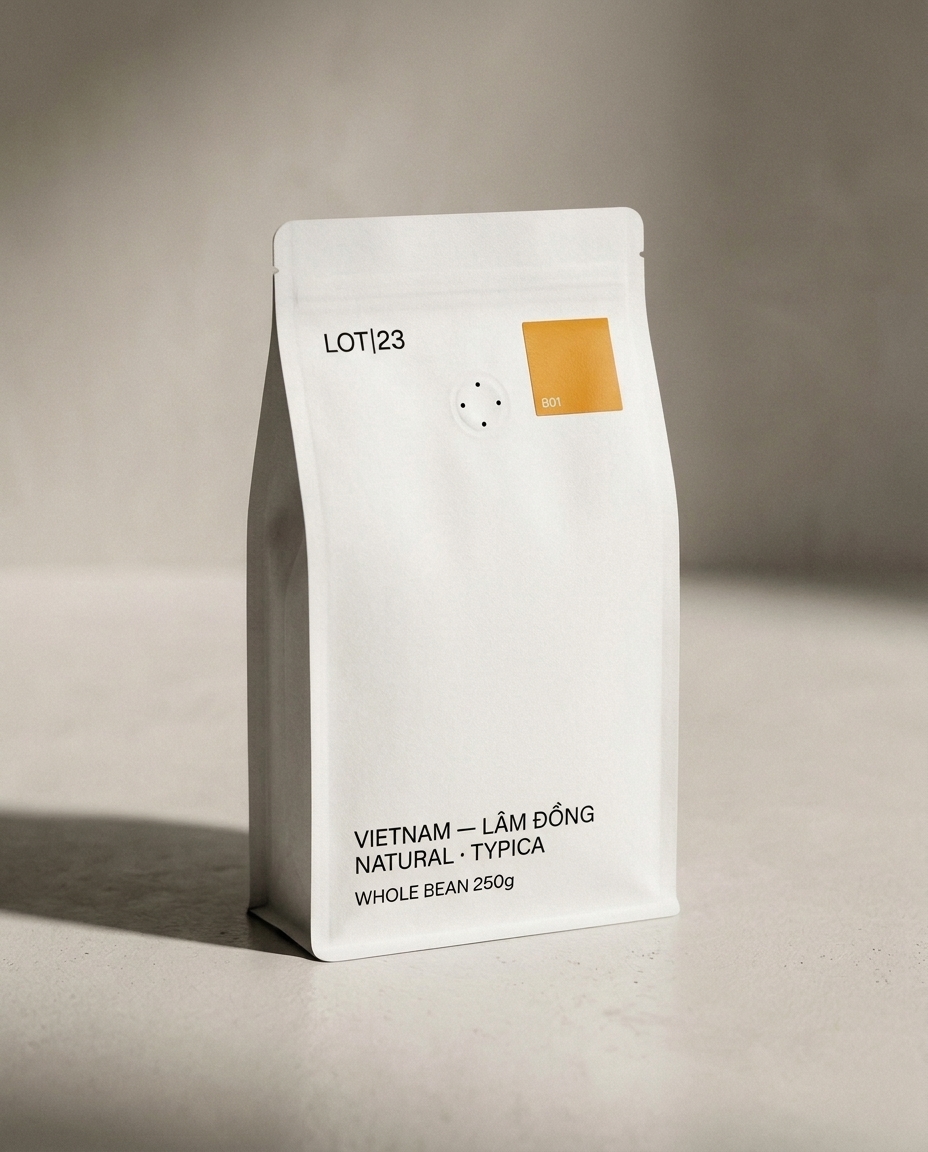
B01-TYP — Vietnamese Typica
Lâm Đồng · natural · pour-over

B02-ROB — Fine Robusta
Lâm Đồng · black honey anaerobic · phin

B04-AFW — Vietnamese Washed Catimor
Lâm Đồng · washed · espresso

B05-CFP — Peach Co-ferment
Lâm Đồng · co-ferment · handbrew